In this article
The best wedding guest activities are easy to understand, optional to join and simple to pause when the reception programme changes. For a mixed-age crowd, plan a small menu rather than one compulsory game: include one quiet activity, one social activity and one higher-energy option, then place each where guests can find it without crossing the dance floor or blocking a route.
Start with the people you are inviting. Older relatives, young children, guests who do not know one another and friends who would rather talk than perform will not all enjoy the same format. A good activity gives people a reason to connect without making participation feel like a test. The couple still gets a lively celebration, while guests can choose the level of involvement that feels comfortable.
Start with the guest mix, not the trend
Before choosing wedding guest activities, write down the practical shape of your guest list. You do not need a profile for every person. A few broad observations are enough to guide the plan:
- Are several guests likely to prefer seated or low-movement activities?
- Will children be present, and will a parent or another responsible adult be nearby?
- Do most guests know each other, or will the activity need to create introductions?
- Is the reception formal and paced, or relaxed with plenty of free-flow time?
- Are there guests who may find loud music, bright lighting or public performance uncomfortable?
- Will guests move between an indoor room, an outdoor area and the dance floor?
These questions change the answer. A table activity can be welcoming at a formal dinner, but it may be forgotten if it is placed far from the tables. A group game can work at a relaxed celebration, but it can feel intrusive when speeches, cultural moments or a meal are already tightly scheduled. The aim is not to entertain every person in the same way. It is to make several kinds of participation available.
Use a simple four-filter test
Run every activity through four filters before you buy materials or add it to the run sheet.
| Filter | Question to ask | What a good answer sounds like |
|---|---|---|
| Mobility | Can guests reach it, use it and leave without squeezing past furniture? | It is on a clear route with a nearby place to sit. |
| Noise | Does it compete with speeches, conversation or music? | It has a quiet window or can be moved away from the programme. |
| Timing | What happens if dinner, photographs or speeches run late? | Guests can start or stop without holding up the reception. |
| Pressure | Does it invite people without demanding a performance? | Guests can watch, contribute privately or opt out. |
If an idea fails two filters, change the format before you commit to it. For example, turn a public quiz into a question card at each table, or offer a short group dance as an optional moment rather than an all-evening expectation. Small adjustments often make an activity usable for many more guests.
Offer quiet activities with a visible result
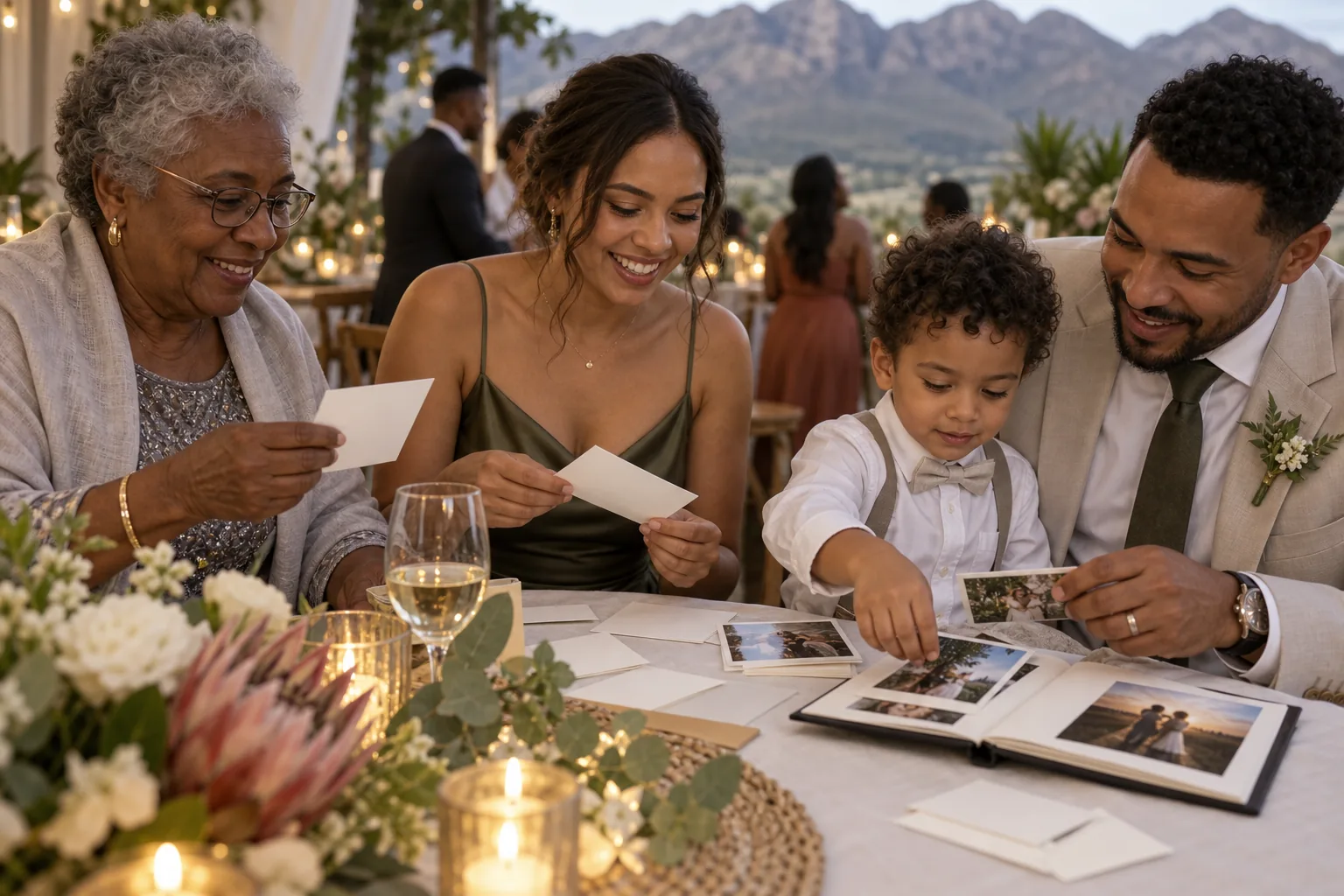
Quiet activities suit guests who want to take part between conversations, courses or formal moments. They are also useful when the reception includes a wide age range because people can join for two minutes or twenty.
Consider:
- advice cards with a clear prompt such as “What should we remember on a difficult day?”;
- a guest book with printed photographs, blank pages and a few example prompts;
- a shared memory table where guests can add a note about one of the newlyweds;
- a postcard box for messages to open on a future anniversary;
- a family photograph or story display with space for guests to add names and context;
- a table of conversation cards that can be used by two people without an announcement.
Keep the instructions short and large enough to read in the available light. Put pens in stable containers, provide enough seating and check whether the table height works for both seated and standing guests. If the result is a book, box or display, assign one person to keep the materials tidy without turning the activity into a job for guests.
The activity does not need to be sentimental. A practical prompt such as “What meal should we learn to cook?” may start a conversation without asking for private information or a public reading.
Add social activities without forcing introductions
Mixed-age wedding guests often need a gentle reason to speak to someone outside their own group. Social activities work best when the first step is obvious and the second step is optional.
Useful formats include:
- a table-based “find someone who” card with ordinary, low-pressure prompts;
- a photo scavenger list that guests can complete in pairs or small groups;
- a shared playlist suggestion card where guests nominate a song and explain why it matters;
- a family or friendship connection board that helps guests identify how they know the couple;
- a small set of lawn or tabletop games with rules printed on one card;
- a prediction card for the couple to read later, without requiring anyone to announce their answer.
Give guests more than one route into the activity. Someone may enjoy finding a prompt but not want to approach a stranger, while another guest may prefer to help a child complete a card. Participation is still successful when guests leave with a conversation, photograph or memory rather than a completed scorecard.
Avoid games that eliminate people early, depend on alcohol or require guests to reveal personal information. Also avoid anything that makes a particular relative responsible for being funny. The reception should have room for humour without placing one person at the centre of it.
Plan one higher-energy option with an easy exit
A mixed-age celebration can include energetic wedding guest activities, but build in a clear exit. Dance-floor games, team challenges and timed group photographs can lift the atmosphere when they are brief and well introduced. They become tiring when guests cannot tell when they are finished.
For a higher-energy option:
- Explain the activity in one short announcement or on a visible card.
- State how long it will last.
- Offer a spectator role, seated version or nearby quiet alternative.
- Keep the route to toilets, exits, tables and the bar clear.
- Let the MC or coordinator end it cleanly before the energy drops.
If children are invited to join, make the boundaries clear and keep adult supervision with the parent or nominated caregiver. Do not design the whole reception around children unless the couple wants that. A small, safe option at a sensible time is often enough.
Match activities to the reception timeline
The same activity can work beautifully or fall flat depending on when it appears. Put each idea beside the moment when guests are most likely to have the attention and freedom to use it.
During arrivals and pre-drinks, guests are still orientating themselves. A memory table, conversation card or simple photograph station can give early arrivals something to do without competing with greetings. Keep the instructions visible and do not rely on the couple to explain them.
During the meal, favour seated activities that can be paused when food arrives or a speech begins. Table prompts, advice cards and small prediction cards are easier to manage than a group game. Keep pens and cards away from plates and glasses, and ask the caterer or coordinator where materials may sit.
After the formal programme, guests usually have more freedom to move. This is a sensible window for a photo booth, dancing, a group photograph or a short team activity. If you are planning a photo booth, choose the operating window around free-flow guest time rather than the entire reception. The guide to how many hours a wedding photo booth needs explains why guest availability matters more than the total venue booking.
At the end of the evening, choose low-effort options. A final message card, a photograph for the guest book or a small display of the evening’s prints can work while guests wait for transport. Avoid starting a complicated game when people are collecting belongings or saying goodbye.
Make photo-led activities work for different guests
Photographs can give a mixed-age crowd a shared task without requiring everyone to dance, compete or speak in front of the room. A photo activity should still offer choices. Guests can take a group photograph, leave a message, help a child pose, add a print to a book or simply look through the finished pages.
If a photo booth is part of the plan, compare the QuikPix photo booth options against the guest mix and the type of keepsake you want. Think about whether older relatives need a nearby chair, whether children need an adult to help, and whether guests can approach without crossing a busy service path. The format should support the celebration, not create a queue that cuts through it.
Printed photographs can also become an activity after the first images are made. Provide a book, adhesive or photo corners, pens and a short prompt. Let guests place a photograph themselves or leave it in a tray for someone else to add later. If you want a digital gallery as well, explain where guests can access it without making a long announcement.
These wedding photo ideas for an elegant, modern reception can help couples connect guest photographs to the room and the keepsake plan.
The QuikPix photo booth planning options can help when you are deciding how the experience should fit the room. Treat the choice as part of the guest journey: entry, participation, print or digital result, and a comfortable way to leave the area.
Check comfort, access and sensory load
Accessibility is not an extra feature to add at the end. It is part of choosing and placing the activity. Walk the route from the main guest area to the activity and back again. Look for steps, loose cables, narrow gaps, glare, uneven ground and furniture that may move during the reception.
Provide at least one nearby seat and avoid making the activity depend on standing for a long period. Keep the writing surface stable. If the activity uses small print, prepare a larger version. If the room is loud, put the main instruction on the card rather than relying only on an announcement.
Use a calm alternative when the main room is loud or crowded. This can be as simple as a quiet table with message cards or a display area outside the busiest route. Do not describe that space as a special area for a particular person. Make it available to anyone who wants a slower moment.
For outdoor activities, check the forecast and agree on a move indoors before the wedding day. South African weather can change quickly in some seasons, so use the South African Weather Service forecast as one planning input, then confirm the actual decision with the venue team. Protect paper, photographs, electrical equipment and guests from wind, rain and direct afternoon sun.
Confirm the practical details with the venue team
Before you pack the materials, send the coordinator a short activity brief. Include:
- the activity name and a one-sentence explanation;
- the expected footprint, tables and chairs;
- setup and pack-down time;
- any power, lighting or sound requirement;
- the person responsible for restocking or tidying;
- the planned quiet window and the planned higher-energy window;
- the indoor backup location for weather or programme changes;
- the access route that must stay clear;
- what happens to messages, prints and other personal contributions afterwards.
Ask who can move the activity if the room changes. Confirm whether candles, adhesives, confetti, outdoor games or temporary signs are permitted. If the activity includes photographs, messages or children, ask how the couple would like the materials stored after the reception.
Do not assume that a venue’s floor plan reflects the final event layout. Tables, bars, dance floors, catering stations and supplier equipment may change the available space. Walk the route in person or mark it on the final plan, then share the same version with the coordinator, photographer, DJ or band and photo booth operator.
A practical wedding guest activity checklist
Use this checklist a week or two before the wedding:
- Choose one quiet, one social and one optional higher-energy activity.
- Match each activity to a realistic free-flow time.
- Write instructions that can be understood without an announcement.
- Provide seating, stable surfaces and a larger-print option.
- Keep exits, service paths, toilets and accessible routes clear.
- Give children an age-appropriate option without making supervision unclear.
- Prepare an indoor backup for every outdoor activity.
- Decide who replenishes materials and collects completed contributions.
- Check that photographs, messages and cards can be stored safely.
- Tell the coordinator how each activity can be shortened or moved.
You do not need a full programme of games to give guests a memorable reception. Two or three thoughtful options, placed well and explained simply, are usually more useful than a crowded schedule. Start with the people in the room, protect their comfort and let participation remain a choice.
If a photo booth is part of your wedding plan, share the guest range, reception timing, activity priorities and venue layout with QuikPix. That information helps the team suggest an operating window and setup that fit the celebration you are actually planning.
Frequently asked questions
What are good wedding guest activities for different age groups?
Choose a mix rather than one activity for every age. Message cards, a guest book, simple conversation prompts and a photo-led activity can work across generations because guests can participate at their own pace. Add one optional energetic idea if it suits the reception, but provide a seated or spectator route as well.
How many wedding guest activities should we plan?
Start with two or three. One quiet option, one social option and one higher-energy option is enough for many receptions. Add more only when the venue, timeline and guest mix can support them without making the programme feel busy.
When should activities happen at a wedding?
Place quiet activities during arrivals or the meal, when guests are already seated or moving slowly. Use social and higher-energy activities during free-flow periods after formalities. Avoid launching a new activity during speeches, dinner service or a planned group photograph.
How can we include guests who do not want to perform?
Make every activity optional and provide a private contribution route. A guest can write a message, add a photograph, answer a card or watch without being called into the middle of the room. Avoid elimination, forced introductions and prompts that require personal disclosure.
For a focused pre-dinner plan, see these cocktail hour entertainment options that keep guests moving before dinner.