In this article
Good wedding reception entertainment during cocktail hour should give guests something easy to join while the couple is away, without creating a queue at the bar or delaying the call to dinner. For most receptions, one anchor activity and one quieter option are enough. Choose formats that can start in the middle, pause when the venue team needs the space, and finish with a clear handover to the reception room.
The best choice depends on the guest mix, the length of the drinks window, the distance between spaces and what the couple wants guests to remember. A photo-led keepsake table, acoustic music, a short hosted activity or a venue-managed tasting station can all work. The practical test is simple: guests should understand how to join, coordinators should know how to stop it, and nobody should have to cross a service route to take part.
Start with the gap you need to cover
Cocktail hour is not always a neat, uninterrupted hour. Guests may arrive in waves, the couple may need more time for formal photographs, and the venue may call people through to dinner earlier than planned. Before choosing wedding reception entertainment, write down the actual gap that needs support.
Ask:
- When will the first guests arrive at the drinks area?
- Will the couple and wedding party be away for photographs?
- Are guests moving between an outdoor garden, a terrace and an indoor dining room?
- Will drinks and canapes be passed, served from a station or collected at a bar?
- What signal will tell guests that dinner is ready?
- Which activity can be paused first if the schedule changes?
This turns a long list of entertainment ideas into a smaller planning decision. If the couple is away for a short period, a quiet activity with a visible result may be enough. If guests will spend longer in a separate area, add a format that creates gentle conversation without requiring a formal announcement.
Wedding reception entertainment ideas for cocktail hour
Use the options below as a shortlist, not a programme to fill at all costs. Two compatible choices usually create more room for conversation than five competing activities.
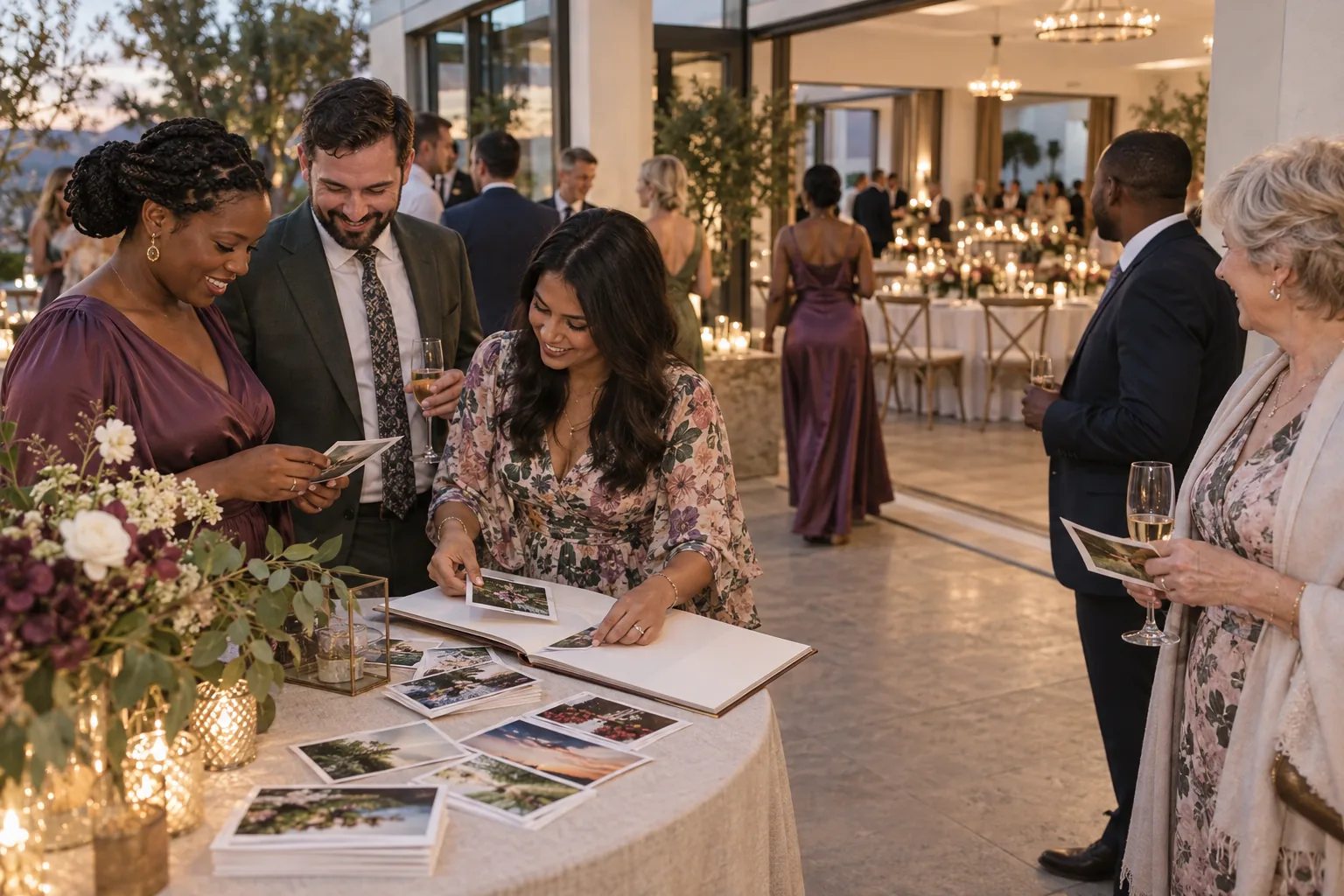
A printed-photo and message table
A table where guests can add a printed photograph, write a message or contribute to a guest book gives people a reason to pause without asking them to perform. It works particularly well when family groups and friends are mixing for the first time.
Keep the setup calm. Provide a stable writing surface, a few clear instructions, pens that are easy to find and enough room for two or three people to stand without blocking the route. Keep drinks and food away from the prints. Decide in advance whether guests place a photograph straight into the book, leave it in a tray or write a message beside it.
If you are considering a photo booth as part of the cocktail-hour plan, compare the QuikPix photo booth options after you know the guest range, desired result and available footprint. The activity should support the reception, not become a second queue that competes with the bar.
Acoustic music with a defined finish
An acoustic musician can make an arrival area feel settled while leaving space for conversation. The useful brief is not simply “play during cocktail hour”. Give the musician the location, sound limits, planned start, dinner-call cue and the person who will confirm the finish.
Avoid placing the performance beside the bar, canape station or narrow entrance. Guests need to hear one another and move freely. If the music will continue as people enter the dining room, agree whether the supplier will stop, move or hand over to the venue sound system.
A venue-managed tasting or demonstration
A tasting station, chef demonstration or local food feature can work when the venue or caterer already controls the service. The advantage is that the activity and food plan can be coordinated together. The risk is that guests gather around one counter and turn a simple feature into a service queue.
Ask the venue team how many access points are needed, where the line will form and what happens if the dinner call moves forward. Keep the activity out of the route used for replenishing drinks and canapes. A tasting that guests can join in small groups is easier to manage than one that requires everyone to wait for a demonstration to begin.
Small games with a seated alternative
Tabletop games, lawn games and simple couple-related prompts can help when the guest list includes people who enjoy participation but do not want a stage moment. Keep the rules on one short card. Avoid games that depend on alcohol, eliminate people early or ask guests to disclose private information.
Every higher-energy option needs an easy exit. A guest should be able to watch, sit down or return to conversation without being marked as a poor sport. If children are invited to take part, make the parent or nominated caregiver responsible for supervision rather than leaving the supplier or MC to guess.
Conversation prompts for mixed groups
Conversation cards can be useful when many guests do not know one another. Use ordinary prompts that do not require a correct answer, such as a favourite local place, a meal the couple should try or a piece of advice for a new home. Place the cards where people can pick one up without blocking the drinks service.
This is a good companion to music or photographs because it does not need a fixed start time. It is also easy to remove if the room becomes busy. The activity has done its job when it starts a few conversations, not when every card has been completed.
Use a four-filter test before booking
Run each proposed activity through the same practical checks. If it fails two filters, change the format or move it before confirming the supplier.
| Filter | Question | A workable answer |
|---|---|---|
| Flow | Will guests reach it without crossing a service route? | It sits beside, not inside, the route to the bar, toilets and dinner room. |
| Noise | Can people still hear one another and the dinner call? | The sound level has a limit and someone owns the finish cue. |
| Flexibility | What happens if photographs or dinner run late? | Guests can join in the middle and the activity can pause cleanly. |
| Pressure | Can guests watch or opt out? | Participation is invited, never announced as an obligation. |
Also look at the activity from a seated guest’s height. A low table, bright afternoon glare or a narrow gap may be obvious when you walk through the space but uncomfortable once the room is full. Include at least one nearby seat and keep the instructions readable in the actual light.
Protect the bar, food and dinner transition
Most cocktail-hour entertainment problems are placement problems. The activity may be attractive, but it competes with the route that guests and staff need most.
Mark these areas on the final venue plan:
- bar queue and collection point;
- canape or tasting service route;
- toilets, exits and accessible paths;
- the route to the dining room;
- the space used by the photographer and wedding party; and
- the area where the MC or coordinator will make the dinner call.
Do not assume that the venue’s first floor plan is the final layout. Tables, umbrellas, bars, heaters and supplier cases may change the available space. The QuikPix wedding venue placement guide covers visibility, queues, access, power and weather backup for a photo experience. Use the same route-checking habit for any cocktail-hour activity.
Give one person authority to close or move the activity. That might be the coordinator, venue manager or MC, depending on the event. The supplier should know who gives the instruction and where materials go next. A clean finish is part of the entertainment brief, not an afterthought.
Match the format to the guest mix
Wedding reception entertainment should make the drinks window easier for the people in the room. Consider the likely mix rather than choosing an idea because it looks good in a supplier gallery.
If guests are meeting for the first time
Choose a low-pressure activity that gives small groups a natural reason to stand together. Printed photographs, simple prompts and quiet music can help without forcing introductions. Keep the instructions visible so guests do not need to find the couple for an explanation.
If several older relatives prefer conversation
Limit volume, provide seating and avoid positioning the activity in a place where people must stand for a long time. A message table or acoustic set may suit the room better than a timed game. The activity can still feel social without asking everyone to dance or compete.
If children will be present
Choose a format with a clear boundary, a safe surface and a nearby adult. Avoid small loose materials in a busy service route. A child-friendly option can be available without making the whole drinks window a children’s programme.
If the venue has indoor and outdoor spaces
Decide which option moves indoors first if the weather changes. Check the forecast through the South African Weather Service as the date approaches, then confirm the final move with the venue. Protect prints, paper, electrical equipment and guests from wind, rain and direct sun.
Give every supplier the same hand-off brief
Once the shortlist is small, put the practical information in one message. This stops the venue, photographer, musician, caterer and photo supplier from working from different assumptions.
Include:
- The cocktail-hour start and the latest acceptable finish.
- The activity footprint, table or chair requirement and access route.
- The power, lighting or sound requirement, if any.
- The person who can pause, move or close the activity.
- The point where guests will be directed when dinner is ready.
- The indoor backup location and the weather decision time.
- What happens to prints, messages, cards or other contributions after the event.
- Any venue approval needed for adhesives, candles, food handling, temporary signs or outdoor equipment.
Share the same version with the coordinator and venue team. If a photo experience is included, the guide to choosing photo booth hours for a wedding can help you separate the total venue booking from the time when guests are actually free to participate.
A simple cocktail-hour run sheet
The exact clock times belong to the couple, venue and caterer. The sequence below helps assign ownership without pretending every wedding follows the same timetable.
| Moment | Guest experience | Owner check |
|---|---|---|
| Before guests arrive | Materials, supplier equipment and routes are ready. | Venue confirms the footprint and safety check. |
| Early arrivals | Guests can join quietly without waiting for a group start. | Coordinator checks that bar and greeting routes stay open. |
| Couple’s photo window | The activity remains available but does not depend on the couple. | Photographer and coordinator share the expected return cue. |
| Dinner warning | The activity starts its finish routine. | One named person gives the message and protects the route. |
| Move to dinner | Guests know where to go and what happens to their contribution. | Supplier packs or leaves the agreed materials without blocking staff. |
This structure is useful for music, games, tastings and photo-led activities. It keeps the supplier brief practical and gives the venue team a way to adjust when the day changes.
The practical choice
For many receptions, the strongest cocktail-hour plan is one easy-to-join anchor activity, one quiet conversation layer and a named finish cue. Choose the option that fits the route and guest mix, then remove anything that competes with dinner service.
If you want a photo experience in the plan, send QuikPix the guest range, venue layout, intended cocktail-hour window and preferred result through the photo booth contact route. That gives the conversation a useful starting point after the planning decision has been made.
Frequently asked questions
What is good wedding reception entertainment during cocktail hour?
Choose an activity that guests can join in the middle and leave without an announcement. Printed photographs and messages, acoustic music, simple conversation prompts, a venue-managed tasting or a small game can all work when the route, noise level and finish cue are planned.
How many cocktail-hour activities should a wedding have?
Start with one main activity and one quieter companion. Add another only if the guest flow, venue space and timeline can support it. A crowded programme can make the drinks window feel like a set of queues rather than a chance to talk.
How do you stop entertainment from delaying dinner?
Place it away from bar and catering routes, make the joining instructions short, assign one person to close it and give the supplier a clear dinner-call cue. Choose formats that can pause without leaving guests waiting for a final round.
Should a photo booth open during cocktail hour?
It can work when guests have enough free-flow time, the footprint is off the main service route and the experience can be paused for the dinner transition. Check the guest count, desired output, venue access and weather backup before choosing the operating window.